AI and ChatGPT in binary options trading
How to use AI and ChatGPT to trade binary options without falling for scams. Real NeuroScript examples and a copy trading comparison.
AI is transforming trading. Investment banks use machine learning models to calculate risk in milliseconds, exchanges rely on algorithms to make markets 24 hours a day, and quant funds apply neural networks to optimize execution. Over the past two years, that same technology has begun reaching the retail trader in very concrete forms: customizable algorithmic indicators, performance-based copy trading, and language models acting as a study copilot.
As with any new trend, offers have also appeared that use "AI" merely as a label to sell an empty promise. The difference between a legitimate tool and misleading advertising almost never lies in the name — it lies in transparency: can you see the logic or not? Is there an auditable track record or not? Do you understand what's happening, or are you trusting blindly?
This article shows three concrete ways for a binary options trader to use AI seriously, starting with the most powerful — algorithmic indicators you build yourself — moving through copy trading, and ending with how LLMs like ChatGPT, Claude, and Gemini can support your learning.
What AI already does in trading today
Before talking about tools, it's worth understanding the real state of the art. AI in financial markets isn't a futuristic promise — it has been infrastructure for years. Where it already works well, according to papers and public reports from major institutions:
- Risk desks at banks that need to calculate exposure across thousands of positions in real time
- Market making on electronic exchanges, setting dynamic spreads based on order flow
- Pricing of exotic options with stochastic volatility models
- Fraud and manipulation detection in real time (spoofing, wash trading)
- Execution optimization for large orders (TWAP, VWAP, participation algos)
Notice the pattern: very short horizons (milliseconds to seconds), an immense volume of data, and a focus on fair price, risk, and execution — not on "guessing whether EUR/USD will go up in the next 5 minutes."
For the retail binary options trader, AI's real promise isn't an oracle that nails the direction. It's something more useful: tools that apply your strategy with absolute consistency, indicators that process thousands of candles without tiring, language models that help you study faster. Used well, AI doesn't replace the trader — it amplifies discipline.
Three legitimate paths for AI in trading
In practice, there are three ways to apply AI to your binary options trading, in order of impact:
Path 1 — Customizable algorithmic indicators
This is the most powerful and, at the same time, the most accessible. An algorithmic indicator is a set of explicit rules applied to price: if the short moving average crosses the long one, draw a signal; if the RSI is below 30 and price touches a support, paint the bottom green. The logic is yours, the calculation is the machine's.
The difference compared to a "paid signal" is profound: you see every rule. If the indicator gets it wrong, you understand why. If it gets it right, you can replicate it. It's not a black box — it's code that any trader with a bit of study can audit, adjust, and improve.
There are several languages for writing algorithmic indicators — Pine Script (TradingView), Python with quant libraries, MQL in MetaTrader. On Futura Broker, the option integrated into the chart is NeuroScript, which we'll cover in detail below.
Path 2 — Copy Trading
Technically this isn't "AI" in the strict sense, but it's an automated system that works far better than most of the "smart" bots sold out there. In copy trading, you pick a real trader on the platform and automatically replicate their trades in your account, with the proportion and limits you define.
The human in the loop is what makes this trustworthy: the trader you copy has a public history, an auditable track record, and is accountable for their own performance. When they do poorly, you see it. When they change strategy, you notice.
Path 3 — LLMs as a study copilot
ChatGPT, Claude, and Gemini are excellent tools for supporting a trader's learning and discipline — as long as you use them for what they do well: explaining concepts, reviewing reasoning, generating checklists, studying known historical patterns. They don't see the market in real time and shouldn't be used as entry generators. We'll come back to this point later.
And what to avoid
On the opposite side of these three paths are anonymous signal offers promising a 90% win rate, "AI robots" costing R$ 97 per month with no verifiable track record, sellers who forget to show the bad days. The rule is simple: if you can't audit the logic or the history, it isn't legitimate AI — it's marketing. To understand more about this kind of offer, read are binary options a scam? The truth.
Building with NeuroScript
NeuroScript is Futura Broker's own language for writing algorithmic indicators that run directly on the platform's chart in real time. It solves a specific problem: turning your strategy into auditable code, with immediate visual feedback on the chart.
Why this changes the game for binary options traders
Successful trading depends on consistency in applying rules. Most beginner trader losses don't come from a wrong rule — they come from inconsistent application of the right rule. You enter because "it looked good," you exit because "it got ugly," you change the strategy mid-day. A custom indicator solves this: it applies your logic every single time, without hesitation, without fatigue, without FOMO.
And, unlike closed signals, you keep full control. You see what's happening. You adjust when needed. You learn from every trade.
Syntax in 60 seconds
The syntax is declarative and inspired by classic technical indicator languages, with a Python influence. You declare inputs, calculate values from price, and plot the result. If you've worked with chart scripting before, the path is short. If you never have, the three examples below are enough to get started.
Example 1 — RSI with colored levels
The RSI changes color depending on whether the value enters overbought, oversold, or neutral territory. You start reading the oscillator at a glance, without checking number by number.
indicator("RSI Levels", shorttitle="RSI", overlay=false)

length = input.int(14, "RSI Period", minval=1, maxval=50)
overbought = input.int(70, "Overbought", minval=50, maxval=100)
oversold = input.int(30, "Oversold", minval=0, maxval=50)

rsi = ta.rsi(close, length)

rsiColor = rsi >= overbought ? color.red
         : rsi <= oversold ? color.green
         : color.blue

plot(rsi, "RSI", color=rsiColor, linewidth=2)
hline(overbought, "Overbought", color=color.red, linestyle=2)
hline(50, "Midline", color=color.gray, linestyle=1)
hline(oversold, "Oversold", color=color.green, linestyle=2)
It's the classic RSI logic with visual feedback. Nothing mystical.
Example 2 — Moving average colored by trend
A simple filter that shows whether price is above or below the average. Useful as a lock to avoid trading against the trend of the higher timeframe.
indicator("Simple SMA", shorttitle="SMA", overlay=true)

length = input.int(20, "Period", minval=1, maxval=200)
sma = ta.sma(close, length)

trendColor = close > sma ? color.green : color.red
plot(sma, "SMA", color=trendColor, linewidth=2)
If price is above the average, the line is green. Below, red. Simple and effective.
Example 3 — RSI + Bollinger confluence
This is where custom indicators get truly powerful: combining two or more conditions. The script below paints a marker on the chart when the RSI is oversold and, at the same time, price touches the lower Bollinger band. This confluence increases the statistical probability of a reversal.
indicator("RSI + Bollinger Confluência", shorttitle="RSI+BB", overlay=true)

rsiLen = input.int(14, "RSI Period")
bbLen = input.int(20, "BB Period")
bbMult = input.float(2.0, "BB Multiplier")

rsi = ta.rsi(close, rsiLen)
basis = ta.sma(close, bbLen)
dev = bbMult * ta.stdev(close, bbLen)
lower = basis - dev

oversoldRsi = rsi < 30
touchedLower = low <= lower

signal = oversoldRsi and touchedLower

plotshape(signal, "Reversão Potencial", color=color.green, location=location.below)
It's the kind of logic that separates a random signal from a setup with probability in your favor — and one you can adjust freely (swap 30 for 25, change the RSI period, add a volume filter).
Using AI to write your own indicator
LLMs work very well as copilots for drafting code. A useful prompt:
"Help me write an indicator in a declarative syntax like Pine Script that paints the chart background green when the RSI (period 14) is below 30 and price is below the lower Bollinger Bands band (period 20, deviation 2). Include customizable inputs."
The model will generate a draft. You paste it into the NeuroScript editor, adjust the syntax if needed, run it on the chart in real time, and refine. This flow — the human designs the logic, AI helps code it, the platform runs it live — is probably the most productive way to create indicators today, for those without strong programming experience.
Honest limitations
It's important to be direct about where NeuroScript is still growing: it's a beta language, with no native historical backtesting (you validate by running in real time and observing the signals), no built-in machine learning (it's explicit logic you program, not automatic training), and not portable to other platforms. The community of public scripts is still forming. None of this takes away from what already works — it's useful to know where the edges are.
If you want to better understand how to activate indicators and adjust parameters before writing your own, read the practical guide to indicators.
LLMs as a study copilot
Language models like these are trained on text — not on live market data. That defines where they help and where they don't make sense.
Uses that work well:
- Explaining indicators you don't master: "Explain MACD with a numerical example and tell me 3 classic situations where it gives a false signal."
- Reviewing a trade after it closed: paste your reasoning ("I entered because the RSI was at 28 and the 1.0720 support held twice") and ask the model to point out possible biases.
- Generating a pre-trade checklist from your strategy: the model is good at turning informal rules into a numbered checklist.
- Drafting NeuroScript code, as shown in the previous section.
Limitations to keep in mind:
- They don't have real-time quotes, so any specific answer about "enter now" is a guess.
- They tend to confirm the bias of the prompt: if you ask for justifications for a thesis, they'll find them. Use this in reverse — ask for counterarguments.
- For specific numbers (win rates, historical returns), always ask for a primary source before trusting them.
The best way to integrate LLMs into your workflow is to see them as a study and review assistant, not an entry generator. You think, the model amplifies your ability to analyze.
Copy Trading — AI + human
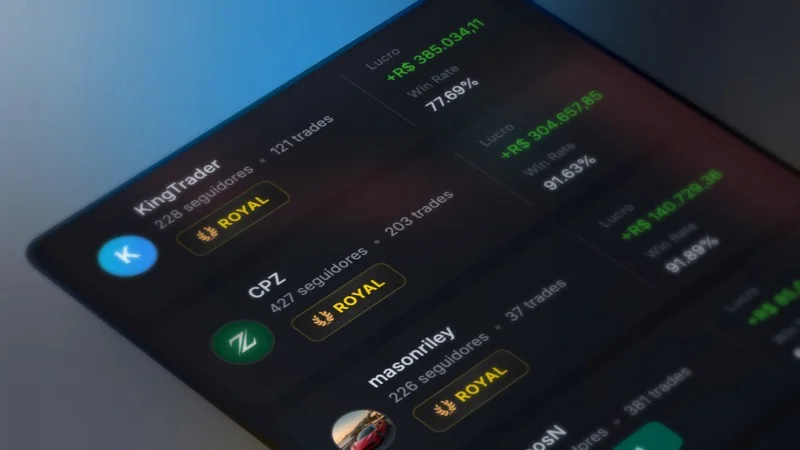
Among the three approaches, copy trading is the one that delivers the most ready-made automation: you pick a trader, configure proportion and limits, and the system replicates the trades. The human in the loop is what makes this trustworthy — unlike an anonymous robot, the trader you copy has a public history on the platform, a visible profile, and an incentive to perform well (the people copying them are visible too).
The table below compares the three legitimate ways to use automation with what you should avoid:
| Dimension | NeuroScript indicators | Copy Trading on Futura | Anonymous signals without audit |
|---|---|---|---|
| Transparency | Open code, you read and adjust | Trader with public history | Black box |
| Control | Full — you define the logic | Proportion, limits, stop balance | None |
| Who trades | You, with the tool's support | Auditable human trader | Unknown |
| Cost | Free on the platform | Clear fee on the platform | Subscription with no trial |
| Fraud risk | None (the audit is yours) | Low (trader operates on the same platform) | Very high |
The first three models coexist well and combine: copy trading to learn by observing, NeuroScript to build your own logic, an LLM to speed up study and coding.
Red flags of any "AI trading" tool
Use this list as a sanity filter before any deposit. Just 2 or 3 signs present are enough to be suspicious:
- A promise of a win rate above 65-70% in marketing material
- The words "no losses," "guaranteed," or "100% profitable" in any communication
- A complete absence of a public, auditable track record
- Pressure to deposit at a specific unregulated broker
- Closed code or algorithm and no history verifiable by third parties
- "Millionaire in 3 months" testimonials with hidden identities
Where AI in trading is heading
Beyond the marketing noise, some directions are genuinely consolidating:
More capable indicator languages. New functions, more statistical primitives, integration with alternative data (news, social media). For the retail trader, this means increasingly sophisticated indicators without having to leave the platform.
Copilots embedded in regulated brokers. LLMs natively integrated into trading platforms — with controlled access to user data — are starting to replace using an LLM in a separate tab. It's a clear trend.
More attentive regulation. The CVM and international bodies have been watching automated signals and robot offers on social media more closely. Expecting an increase in oversight of "miracle AI" over the next 12-18 months is reasonable — which is good for serious traders.
How to start today without risking money
- Open a demo account on Futura — virtual balance, no deposit.
- Copy one of the three NeuroScript examples from this article, paste it into the platform's editor, and watch the indicator running on the chart in real time.
- Use an LLM to review 5 of your trades at the end of the day — ask for counterarguments to your reasoning, not entries.
- Test copy trading with a stop balance that limits your daily loss to the amount you're willing to lose, in demo only.
- Before moving to a real account, read bankroll management and avoid the 5 classic beginner mistakes.
This path gives you two weeks of learning before a single real cent comes into play.
Frequently asked questions
Can I use ChatGPT to trade binary options?
As a study and review copilot, yes. As a real-time entry generator, no — the model doesn't see the current price, so any specific answer about "enter now" becomes a guess. Use it to explain indicators, generate a pre-trade checklist, draft NeuroScript code, and review your reasoning after the trade has closed.
Can I use AI to write my own indicators?
Yes, and it's one of the most productive uses today. You describe the logic in natural language, the LLM generates a draft in indicator syntax, you paste it into Futura's NeuroScript editor and test it in real time. A trader new to programming can create their first functional indicators in minutes.
Are trading robots banned in Brazil?
There's no general ban. What's banned is fraud — and a good chunk of the "infallible robots" sold by anonymous sellers for a fixed monthly fee are exactly that. Legitimate AI robots and tools exist in regulated brokers, professional funds, and academic research, and they stand apart through transparency, auditing, and a public track record.
Does NeuroScript replace TradingView's Pine Script?
They're different tools with similar purposes. NeuroScript is Futura's language, runs integrated into the platform's chart, and is optimized for that. If you use TradingView, Pine Script is still there. If you trade on Futura and want to create your own indicators with real-time feedback, NeuroScript is the native path.
Do I need to know how to program to use AI in my trading?
No. You can use copy trading without writing a single line of code. You can use ready-made indicators from the NeuroScript community. You can use an LLM in natural language. Programming opens up more possibilities — but it's optional.
Which free AI tools are worth it in 2026?
For study, review, and drafting: ChatGPT, Claude, and Gemini in their free tiers. For creating custom indicators: Futura's NeuroScript editor (free for account holders, including demo). For human-based automation: Futura's copy trading.
AI in trading is real where you can see the logic. It's a myth where they promise you magic percentages without showing how. The difference always lies in being able to audit what's happening — whether in the code of a NeuroScript indicator you wrote, in the history of a trader you're about to copy, or in the reasoning you reviewed with an LLM.
Before applying any of these three approaches with real money, the recommendation is simple: test each one in a demo account for at least two weeks, log the results in a trading journal, and always prefer tools whose logic you can explain. There's no shortcut to building intuition in trading — there's only honest practice, repeated and reviewed.