How to Choose a Trading Broker
8 essential criteria for evaluating a binary options broker before depositing your money. Complete checklist and red flags.
You've decided to start trading binary options. You searched on Google, found 20 different brokers — each one claiming to be the best, to have the highest payout, to pay out the fastest. How do you tell the serious ones from the ones that will vanish with your money?
The truth is that most people choose a broker based on marketing. They see a slick ad, an influencer making a recommendation, or they simply go with the first one that pops up. Then they find out that withdrawals take weeks, support never answers, or the assets disappear right when they need them most.
In this article, we'll list the 8 criteria that truly matter when choosing a binary options broker. These are objective criteria — you can use them as a checklist to evaluate any platform before putting in a single cent. If you're not yet sure exactly what binary options are, first read the complete guide on what binary options are and how they work.
1. Free demo account with no restrictions
This is the first filter. If the broker doesn't offer a demo account, or requires a deposit to unlock it, move on to the next one.
The demo account is the only way to test the platform without risk. You need to know how the chart works, how the buttons respond, how the indicators behave, how the price moves in real time. None of that can be assessed by reading the marketing page.
What to look for:
- A generous virtual balance (R$ 5.000+) to simulate real trades
- No expiration date — some brokers disable the demo after 7 days
- The same assets and the same prices as the real account — if the demo has different assets, it's no good as a test
- The ability to top up the virtual balance as many times as you want
Red flag: a broker that only unlocks the demo after you deposit. That's the opposite of the whole point of a demo account.
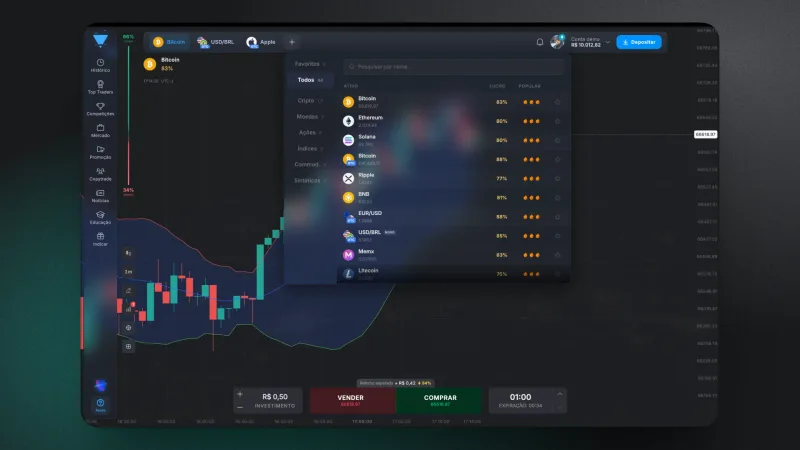
At Futura Broker, the demo account comes with R$ 10.000 in virtual money, runs on the same assets and prices as the real account, and you can recharge it as many times as you want. You don't have to deposit anything to access it. To better understand the difference between the two accounts and when to switch to the real one, read demo account vs real account.
2. Minimum deposit and payment conditions
You're testing a new platform. It makes no sense to deposit R$ 1.000 just to "see if it works." The minimum deposit says a lot about who the broker wants to serve.
What to look for:
- A low minimum deposit — ideally below R$ 100
- Local payment methods. If the broker doesn't offer fast local payment methods, you'll have to rely on international bank transfers or cryptocurrency — which adds time, fees, and complexity
- No hidden fees on the deposit. The amount you send is the amount that shows up in your account
- Fast crediting — depositing and waiting 3 business days to see the balance is unacceptable in 2026
Red flag: a broker that only accepts deposits via cryptocurrency or international transfer. This usually indicates that it lacks the infrastructure to operate in the Brazilian market, or that it's avoiding local regulations.
In practice: at Futura Broker, the minimum deposit is R$ 60, credited within minutes. No additional fee. For the complete step-by-step on how it works, read the tutorial how to make a deposit and withdrawal.
3. Payout: the return percentage
The payout is the percentage you receive when you win a trade. If the payout is 84% and you invested R$ 100, you receive R$ 184 (your R$ 100 + R$ 84 in profit). If you lose, you lose the R$ 100.
It seems like a detail, but the payout defines the entire math of your trading over the long term.
The calculation nobody does:
With a 50% win rate (half win, half lose), the minimum payout for you to break even is ~100%. Since no broker offers 100%, you need to win more than you lose. The question is: how much more?
| Payout | Minimum win rate to break even | Margin |
|---|---|---|
| 75% | 57.1% | Tight |
| 80% | 55.6% | Reasonable |
| 84% | 54.3% | Comfortable |
| 90% | 52.6% | Good cushion |
The difference between a 75% and an 84% payout seems small, but it completely changes long-term viability. At 84%, you need to win 55 out of every 100 trades to come out ahead. At 75%, you need 58. Those 3 extra trades make a real difference.
What to look for:
- A base payout of at least 80% on most assets
- Transparency — the payout should appear on the BUY and SELL buttons before you confirm
- Consistency — there's no point in advertising "up to 95%" if in practice most assets pay 70%
Red flag: a broker that advertises "payout up to 95%" in giant letters but doesn't show the real payout of each asset before the trade. Or one that changes the payout without notice during the day.
At Futura Broker, the base payout is around 84% and appears directly on the trade buttons. On top of that, as you climb tiers (Standard → Safira → VIP → Royal), you earn progressive bonuses: Safira +1%, VIP +3%, Royal +4%. This means that at the Royal level, trades that would pay 84% start paying 88%. Over hundreds of trades, this difference is significant. To understand how these numbers impact your bankroll, read the definitive bankroll management guide.
4. Asset variety
Few brokers explain why asset variety matters. It's not just about "having more options." It's about having something to trade at any time and in any market condition.
What to look for:
- Crypto (BTCUSDT, ETHUSDT, etc.) — market open 24/7 during regular hours
- Forex (EUR/USD, GBP/USD) — active during the London and New York sessions
- Stocks (Apple, Tesla, Google) — generally available during US business hours
- Commodities (Gold, Oil) — useful in moments of economic instability
- OTC assets — this is the most important differentiator
Why OTC is essential:
OTC (Over The Counter) assets are over-the-counter market assets, available 24 hours a day, 7 days a week. They don't depend on an exchange. This means you can trade in the middle of the night, on weekends, and on holidays.
If the broker doesn't offer OTC, you're limited to business hours. And when the market is closed — which happens for more than 60 hours a week — you simply have nothing to do. To understand in depth how OTC works and which assets are available, read What OTC is in binary options.
Red flag: a broker with fewer than 20 assets, or one that doesn't offer OTC. Also be wary of brokers that list many assets but only operate during limited hours.
At Futura Broker, there are more than 100 assets across crypto, forex, stocks, and commodities, including 16 OTC assets available 24/7. This ensures there's always something to trade, no matter the time.
5. Analysis tools
Trading while only watching the price go up and down is like driving without a dashboard — you might get there, but you don't know how fast you're going, how much fuel you have, or whether the engine is overheating.
What to look for:
- Technical indicators integrated into the chart — at a minimum: Moving Averages, RSI, MACD, Bollinger Bands, Stochastic
- Multiple timeframes — being able to switch between 1 minute, 5 minutes, 15 minutes, etc. to analyze the context
- Candlestick chart — essential for technical analysis. A line chart is no good for serious trading
- Drawing tools — trend lines, support/resistance, channels
Advanced differentiator:
Some platforms go beyond standard indicators and offer customizable indicators or scripts created by the community. This allows more experienced traders to create and share their own analysis tools. At Futura Broker, NeuroScript lets you create custom indicators, and the Scripts page has dozens of indicators created by other traders that you can use for free.
Red flag: a broker with a basic chart (line only, no candles), no indicators, or one that charges to unlock indicators. If the analysis tools are poor, the broker isn't investing in your growth as a trader — it's investing in your dependence.
To learn how to use indicators in practice, read the tutorial how to use indicators on the chart. And if you want to understand the most fundamental concept of technical analysis before any indicator, start with support and resistance in practice.
6. Withdrawal speed and conditions
This is where many brokers show who they really are. Depositing is always fast — everyone makes it easy to get money in. The difference shows up when it's time to take it out.
What to look for:
- A clear processing time — ideally 24 to 48 hours. Anything above 72 hours is suspicious
- A reasonable minimum withdrawal amount — below R$ 200
- A transparent fee — disclosed before you request the withdrawal, with no surprises
- A withdrawal method compatible with the deposit method — you receive through the same method you used to deposit. Simple
- No "hidden conditions" — some brokers require you to trade X times the deposited amount before you can withdraw. Read the terms
Red flag: a vague withdrawal timeframe ("up to 30 business days"), a high fee with no justification, a minimum withdrawal amount far above the minimum deposit, or "trading volume" requirements to release the withdrawal. If withdrawing is hard, the broker is profiting from your money sitting idle in the account.
At Futura Broker, the minimum withdrawal is R$ 120, with a 4.99% fee. The timeframe is up to 48 business hours. The amounts and fees are disclosed before the request — no fine print.
7. KYC and security
"KYC" stands for Know Your Customer — it's the identity verification process. You submit a photo ID, and the broker confirms that you are who you say you are. It looks like bureaucracy, but it's protection.
Why KYC is good for you:
If someone accesses your account and tries to withdraw to a different bank account, KYC prevents it. If the broker runs into a legal problem, having KYC means your money is tied to your identity — not to an anonymous email. If there's fraud, there's a trail.
About "brokers without KYC":
Many people look for brokers without KYC for convenience. Nobody likes submitting documents. But think about it this way: a broker that doesn't know who its customers are also can't protect them. If your money disappears, who do you complain to? If there's no verification at all, anyone can create an account in your name.
A broker without KYC isn't a benefit — it's a sign that the platform doesn't want to be held accountable.
What to look for:
- Identity verification (KYC) — preferably simple and fast (selfie + document)
- A secure connection (HTTPS) across the entire platform
- A clear privacy policy — specifying what is collected and how it's used
- Two-factor authentication (2FA) available
Red flag: a broker that asks for no verification, or that requests sensitive data through insecure channels (WhatsApp, unencrypted email).
8. Support and community
Problems will happen. A balance that didn't show up, a trade that froze, a question about a withdrawal. The question isn't whether you'll need support — it's whether support will be there when you do.
What to look for:
- Support in your language — it seems obvious, but many brokers offer support only in English
- A reasonable response time — up to 24 hours by email, minutes by live chat
- Multiple channels — in-platform chat, email, social media. If there's only one channel, it's not support — it's a contact form
- An active community — traders using the same platform sharing strategies, indicators, and experiences. This doesn't depend solely on the broker, but serious platforms foster this kind of environment
Red flag: support only by email with an "up to 7 business days" timeframe, a chat that's just a bot with no option to talk to a human, abandoned social media accounts or ones full of complaints with no response.
Quick checklist
Before depositing with any broker, go through this list:
| Criterion | What to look for | Red flag |
|---|---|---|
| Demo account | Free, no expiration, generous balance | Requires a deposit to unlock |
| Minimum deposit | Low, no fees | Crypto or international transfer only |
| Payout | ≥ 80%, visible before trading | "Up to 95%" that's actually 70% |
| Assets | 40+, including OTC 24/7 | Fewer than 20, no OTC |
| Tools | Technical indicators, candlestick chart | Basic chart, paid indicators |
| Withdrawal | 24-48h, clear fee | Vague timeframe, high minimum |
| KYC | Identity verification | No KYC = no protection |
| Support | In your language, fast | English only, no human |
If the broker fails more than 2 of these criteria, it's probably not worth the risk. If it fails on KYC or withdrawals, it's definitely not worth it.
Why these criteria matter more than the marketing
It's easy to be impressed by a slick landing page, a payout "up to 95%," or an influencer showing off profit screenshots. But none of that matters if:
- You can't withdraw when you need to
- Support doesn't answer when something goes wrong
- The platform has no tools for you to grow
- The demo doesn't work properly for you to test
The broker is the foundation of everything. If the foundation is unstable, it doesn't matter how good your strategy is — you'll run into problems. Choose carefully, test on the demo, and start with the minimum.
Choosing a broker is the first step — but it's not the last. Once you've chosen, check out the tutorial on how to place your first trade for a practical step-by-step. And if you want to avoid the most common mistakes beginners make after choosing a platform, read the 5 mistakes every beginner trader makes.
Go to futurabroker.com and test it on the demo account — no deposit, no commitment. If the platform passes all 8 criteria, the next step is yours.