What Is OTC? A Guide for Traders
Learn what OTC is in binary options, which assets are available 24/7, and how to trade Futura Broker over-the-counter market.
It is Saturday night. You want to trade, you open the platform, and you see that several assets are available — the chart is working, prices are moving, trades are open. How? Isn't the exchange closed? Aren't the exchanges in maintenance?
These are OTC assets. OTC stands for "Over The Counter." These are assets that do not depend on stock exchanges or crypto exchanges to operate. At Futura Broker, there are 16 OTC assets available 24 hours a day, 7 days a week, no exceptions. Weekends, holidays, the small hours — there is always something to trade.
In this article, you will understand what OTC assets are, how they differ from regular-market assets, which ones are available, and how to use each one to your advantage. If this is the first time you have heard of binary options, start with what binary options are. If you already know the basics, keep reading here.
What the OTC market is
OTC is a financial-market term that has existed for decades. The acronym comes from "Over The Counter." The idea is simple.
In the traditional market — the stock exchange, crypto exchanges — trades go through a central entity that connects buyers and sellers. It only works when that entity is open. The American exchange (NYSE) opens from 9:30 a.m. to 4:00 p.m. (New York time). Outside those hours, nothing happens.
In the OTC market, trades happen directly between the parties, with no central intermediary. That is why it does not depend on exchange hours.
At Futura Broker, OTC assets use prices generated by mathematical models that simulate real market behavior. This ensures realistic price movements and uninterrupted availability. Technical analysis works the same way: candles, indicators, support and resistance — everything applies normally to OTC assets.
Think of it this way: the regular market is a store that closes at 6 p.m. OTC is a 24-hour store.
Why trade OTC
The concrete benefits for those who trade binary options.
24/7 availability
Traditional markets have set hours. The American exchange opens from 9:30 a.m. to 4:00 p.m. (ET). Crypto exchanges usually run 24/7, but they can have maintenance or instability. OTC never stops. Weekends, holidays, the small hours — always available. If you work during the day and can only trade at night or on weekends, OTC is for you.
Variety of assets
There are 16 assets across 4 categories: shares of global companies, cryptocurrencies, forex pairs, and indices. Access to assets like Google, Tesla, and Apple at any time — without waiting for the American exchange to open.
Consistency
No market open and close gaps. Continuous, smooth price movements. Ideal for practicing chart reading and testing strategies at any time.
Same trading environment
Same interface, same chart, same indicators. Same mechanics: choose the asset, set the amount and time, click BUY or SELL. Nothing changes in the experience — only what is behind it changes.
All available OTC assets
The complete list of the platform's 16 OTC assets, organized by category:
| Category | Asset | Name | Available |
|---|---|---|---|
| Stocks | GOOGLE-OTC | Google (Alphabet) | 24/7 |
| Stocks | AMAZON-OTC | Amazon | 24/7 |
| Stocks | TESLA-OTC | Tesla | 24/7 |
| Stocks | APPLE-OTC | Apple | 24/7 |
| Stocks | MSFT-OTC | Microsoft | 24/7 |
| Stocks | META-OTC | Meta (Facebook) | 24/7 |
| Crypto | BTCUSDT-OTC | Bitcoin | 24/7 |
| Crypto | ETHUSDT-OTC | Ethereum | 24/7 |
| Crypto | SOLUSDT-OTC | Solana | 24/7 |
| Crypto | ADAUSDT-OTC | Cardano (ADA) | 24/7 |
| Crypto | XRPUSDT-OTC | Ripple (XRP) | 24/7 |
| Forex | EURUSD-OTC | Euro/Dollar | 24/7 |
| Forex | GBPJPY-OTC | Pound/Yen | 24/7 |
| Forex | USDJPY-OTC | Dollar/Yen | 24/7 |
| Indices | IDXUSDT | USD Index | 24/7 |
| Indices | MEMXUSDT | MEM Index | 24/7 |
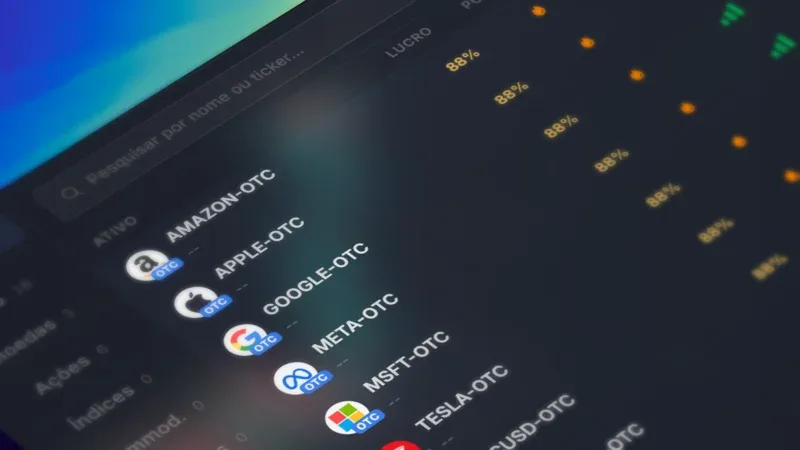
All of them are identified with an "OTC" badge in the asset selector. For OTC stocks, you do not need to wait for the NYSE or NASDAQ to open. OTC crypto works independently of exchanges like Binance. OTC forex operates even when the currency market is closed on weekends.
OTC vs the regular market: what changes in practice
The direct comparison so you understand the differences exactly:
| Aspect | OTC | Regular market (Binance) |
|---|---|---|
| Availability | 24 hours, 7 days | Depends on market hours |
| Base payout | ~80% | ~85% |
| Price source | Mathematical models | Real Binance data |
| Volatility | Consistent | Varies with the market |
| Indicators | All work | All work |
| Candle analysis | Works normally | Works normally |
| Best for | Off-hours, practice, consistency | Business hours, "purer" signals |
About the payout
The 5% difference in payout (80% vs 85%) seems small, but it affects the math. With an 80% payout, you need to win ~55.6% of your trades to break even. With 85%, ~54%. That ~1.6% difference in break-even means your strategies need to be a bit more precise in OTC.
Badge bonuses help close that gap: with the Sapphire badge the payout rises to 81%, VIP to 83%, and Royal to 84% — almost matching the regular market.
It is not a reason to avoid OTC — it is a reason to trade with more discipline.
About the prices
OTC prices are generated by models that simulate real market movements. This means candlestick patterns, support and resistance, and technical indicators all work normally. The difference is that the price is not tied to a real exchange — but the price behavior follows the same laws of simulated supply and demand. For short-term trades (1-5 minutes), chart reading is the same.
How to find and select OTC assets on the platform
The step-by-step is straightforward:
- Open the asset selector (click the name of the current asset at the top of the chart)
- OTC assets are identified with an "OTC" badge next to the name
- You can find them in every category: Stocks, Crypto, Currencies, Indices
- OTC assets show 3 volatility bars — indicating active price movements
- Click the OTC asset you want — the chart switches instantly
In practice, the experience is identical: same candlestick chart, same indicators, same BUY and SELL buttons. If you have already traded a regular asset, you know how to trade OTC. The interface is the same — only what is behind it changes.
Tip: favorite your preferred OTC assets by clicking the star — they appear first in the "Favorites" tab.
Timeframes and expiration in OTC
OTC assets support 6 timeframes:
- 5 seconds, 10 seconds, 15 seconds, 30 seconds, 1 minute, and 5 minutes
For binary options, the recommendation stays the same: expiration should match the timeframe. A 1-minute chart with a 1-minute expiration. A 5-minute chart with a 5-minute expiration. It is the same rule from the strategies for beginners.
Recommendation for beginners: a 5-minute chart with a 5-minute expiration. It is the balance between signal frequency and reliability.
Smaller timeframes (5s, 10s) are for fast scalping — they require more experience and quick reactions. If you are just starting, stick to 5 minutes. Once you are confident reading candles, try 1 minute.
To learn how to read candles on any timeframe, see how to read a candlestick chart.
Your strategies work in OTC
The most common question: "do my indicator strategies work on OTC assets?" The answer is yes.
OTC price movements follow technical patterns — trends, reversals, consolidations. Indicators calculate based on price, regardless of the source. If the price forms patterns — and it does — your indicators work.
Strategies that apply directly:
- Parabolic SAR: the dots indicate the trend the same way. If they flip above the candles, it is a downtrend. It works the same in OTC.
- Supertrend + RSI: the trend + momentum combination works on any asset. Same logic: green Supertrend + RSI coming out of 30 = entry.
- Bollinger Bands + Stochastic: a band touch with Stochastic confirmation — OTC generates the same ranging patterns.
Details on each strategy are in the article on 3 simple strategies for beginners.
Support and resistance in OTC
Support and resistance zones form normally on OTC assets. The rule is the same: price reversed 2-3 times in the same zone = a valid level. Full details in support and resistance in practice.
Technical analysis reads the price, not the source. If the price forms patterns — and it does — your indicators and strategies work.
Payout and bankroll management in OTC
With an 80% payout (standard OTC), the math shifts subtly:
- Break-even: ~55.6% win rate (vs ~54% with the regular market's 85%)
- In practice, for every 100 trades, you need to win ~2 more in OTC
What to do in practice:
- Be more selective. In OTC, wait for clearer signals before entering
- Use the same management rules: 1-3% of your capital per trade
- Do not increase the amount to "make up for" the lower payout — that is one of the 5 mistakes every beginner trader makes
Badges increase the payout: Sapphire (81%), VIP (83%), Royal (84%).
The definitive guide to bankroll management explains how to calculate the ideal amount per trade — the formula applies to both OTC and the regular market.
When to trade OTC and when to trade the regular market
| Situation | Where to trade |
|---|---|
| Weekends and holidays | OTC (the only option) |
| The small hours (markets closed) | OTC |
| Business hours, active market | Regular market (higher payout) |
| Practicing new strategies | OTC (constant availability) |
| Testing on the demo account | OTC or regular (both available) |
| Want signals based on real prices | Regular market |
| Want consistency and predictability | OTC |
The simple rule: if the regular market is open and active, prefer it for the higher payout. When it is not, use OTC.
OTC is excellent for practice — you can test candle reading and indicators at any time without waiting for the market to open. Experienced traders use both: the regular market during the day, OTC at night and on weekends.
If you are deciding between a demo account and a real account, read demo account vs real account.
Practicing in OTC
A concrete training plan to start right now:
- Open the practice account, select BTCUSDT-OTC, the 5-minute chart
- Watch 10 candles. Identify trends, long wicks, reversal patterns — the candle reading you already know
- Turn on Supertrend and RSI — see how the indicators behave on the OTC asset
- Make 10 trades with the minimum amount. Note: asset, indicator used, result
- Compare your results in OTC with your results in the regular market
- Repeat on the weekend — when OTC is the only option
To turn on indicators: how to use indicators on the chart.
The 7 rules of the OTC trader
- OTC runs 24/7 — use it when regular markets are closed.
- The payout is ~5% lower — make up for it with stricter signal selection.
- Technical analysis works normally — candles, indicators, and S&R apply.
- Prefer the 5-minute timeframe — it balances signals and reliability.
- Do not increase the amount per trade — the management rules are the same.
- Use OTC to practice — constant availability is ideal for training.
- Combine both — the regular market during the day, OTC off-hours.
OTC is not an inferior market — it is a different market, with its own rules and a huge advantage: it is always open. Most traders cannot trade only during business hours. OTC solves that.
Now that you understand the OTC market, combine it with the tools you already know: candle reading, indicators, and bankroll management.
Go to futurabroker.com, select an OTC asset, and start trading — anytime, on the practice account.